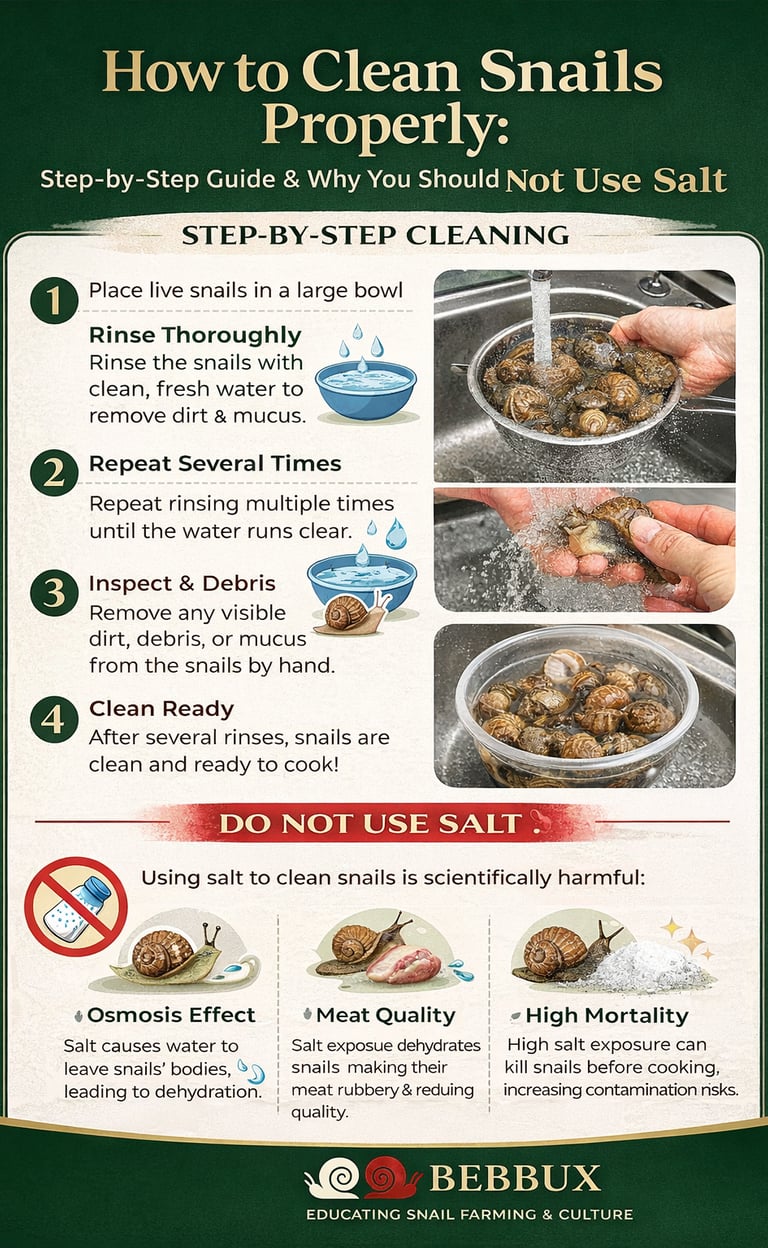
🐌 Why You Should Wash Snails with Water Only
The Science Behind It
3/16/20262 min read
Cleaning snails properly is a critical step in both food safety and product quality. While traditional practices sometimes involve the use of salt, scientific evidence suggests that washing with clean water alone is sufficient—and often preferable.
💧 Water Washing: What the Evidence Shows
Research into food safety has demonstrated that simple washing and rinsing with water is highly effective at removing snails and contaminants.
A study published on PubMed Central found that washing and rinsing produce with tap water was just as effective as using salt or chemical solutions in removing snails and slugs.
Importantly, complete removal was achieved through repeated rinsing, not through the use of salt or additives.
👉 This supports a key principle:
Mechanical cleaning (water + repetition) is more important than chemical treatment.
🧬 Why Salt Causes Damage (The Science)
Snails are highly dependent on water for survival. Their bodies are soft, permeable, and sensitive to environmental changes.
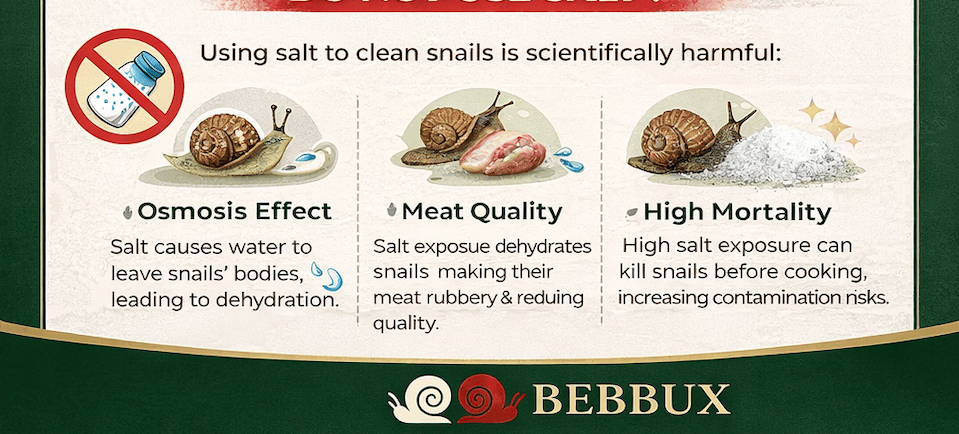
When salt is applied, a process called osmosis occurs:
Water rapidly leaves the snail’s body
Cells shrink and dehydrate
The animal experiences extreme physiological stress
Scientific explanations confirm that:
“Salt essentially draws the water out… and they die within minutes of dehydration”
This reaction is why snails produce large amounts of mucus when exposed to salt—it is a stress response.
⚠️ Practical Implications for Food Preparation
Using salt during cleaning can negatively affect:
1. Meat Quality
Tissue dehydration alters texture
Can lead to rubbery or damaged flesh
2. Animal Condition Before Processing
Premature death reduces freshness
Increases risk of spoilage
3. Hygiene Risks
Dead or stressed snails release internal fluids
This may increase microbial contamination risk
🌍 Environmental and Biological Evidence
Studies on environmental exposure to salt show that snails are extremely sensitive to increased salinity levels.
For example, research on freshwater ecosystems found that:
Increased salt exposure significantly increases snail mortality
Stress factors combined with salt can increase deaths by up to 60%
👉 This reinforces that salt is not just a cleaning agent—it is a biological stressor.
⚖️ Traditional Practices vs Modern Understanding
In some culinary traditions, salt has been used to help remove slime. However:
The primary cleaning effect comes from repeated washing, not salt
Even traditional methods still rely heavily on multiple water rinses.
Modern best practice prioritises:
✔ Controlled purging (feeding/fasting)
✔ Thorough rinsing with water
✔ Avoidance of unnecessary stress
✅ Best Practice Recommendation
✔ Rinse snails thoroughly with clean water
✔ Repeat washing multiple times
✔ Remove visible debris manually
✔ Avoid salt during the cleaning stage
Created by Derek D'Amato (DBA Researcher)
Triagon Academy, Malta
Research Based Information
Derek D'Amato