
🐌 How Snails Drink Water
Understanding Snail Hydration
3/16/20263 min read
Bebbuxpedia – Understanding Snail Hydration
Snails are remarkable animals with biological adaptations that allow them to survive in environments where water is not always readily available. A common misconception among many people is that land snails need a pond or a bowl of water in order to drink. In reality, most land snails rarely drink water in the way mammals or birds do. Instead, they rely on the natural moisture present in their environment to stay hydrated. Understanding how snails obtain water is important not only for people who keep snails in terrariums or snail farms, but also for gardeners and nature enthusiasts who want to support healthy snail populations.
Land snails belong to a group of animals known as gastropods, and their bodies are specially adapted to live in moist environments. Their skin is soft, permeable, and constantly coated with mucus, which helps maintain moisture and protects their tissues from drying out. Because their bodies can easily lose water through evaporation, snails are naturally drawn to humid conditions and tend to be most active during the night, early morning, or after rainfall. These environmental conditions allow them to move safely without losing too much moisture.
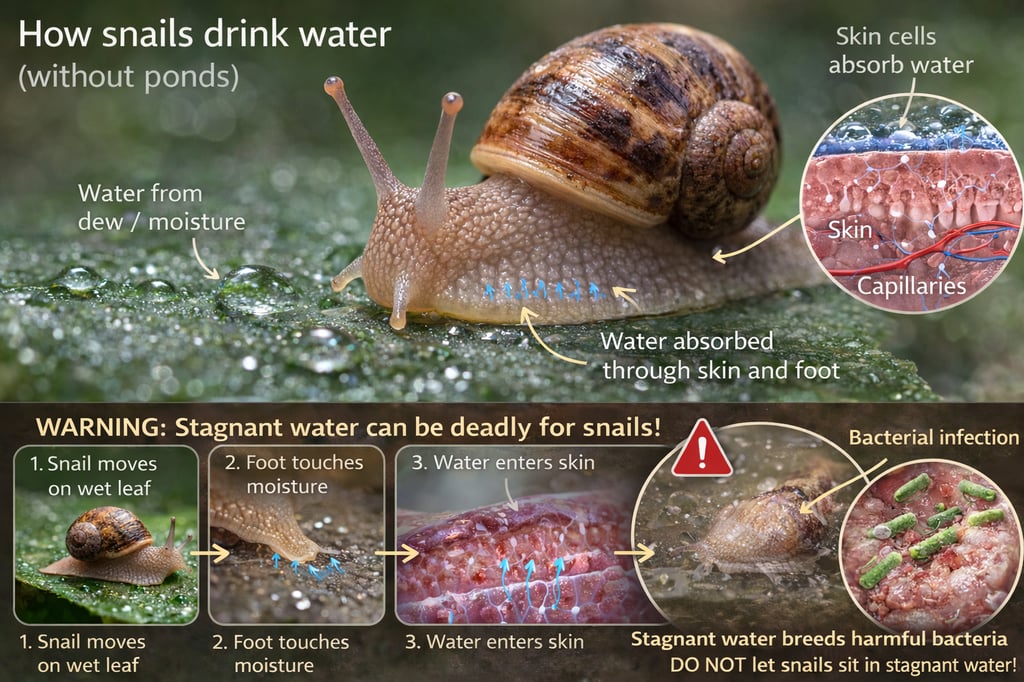
One of the main ways snails obtain water is through direct absorption from moist surfaces. When a snail moves across wet soil, damp leaves, or surfaces covered with dew, a thin film of water forms between the snail’s foot and the surface it is crawling on. The snail’s skin and foot tissues can absorb this moisture gradually, allowing water to enter the body without the need for drinking in the traditional sense. This is why snails are frequently seen moving across plants and soil early in the morning when dew is still present. Even a very thin layer of moisture is enough for the snail to absorb small amounts of water as it moves.
Humidity also plays a crucial role in the hydration of snails. In environments where the air contains a high level of moisture, snails lose less water through evaporation and can maintain their internal balance more easily. This is why snails are commonly found in shaded gardens, forests, and areas with dense vegetation where humidity levels remain relatively stable. When conditions become too dry, many snails will retreat into their shells and produce a temporary seal known as an epiphragm, which helps reduce water loss until the environment becomes moist again.
Another important source of hydration for snails comes from their diet. Many of the foods that snails consume contain high amounts of water. Leaves, fruits, and vegetables provide both nutrients and hydration. For example, leafy greens, cucumber, zucchini, and other soft plant tissues contain large quantities of water that contribute to the snail’s overall moisture intake. As snails feed, they obtain not only the energy they need to survive but also a significant portion of the water required to maintain their bodily functions.
Because of these natural mechanisms, snails do not require standing water sources such as ponds or bowls of water. In fact, providing stagnant water can sometimes create more problems than benefits. Stagnant water can quickly become a breeding ground for harmful bacteria and microorganisms. When snails come into contact with contaminated water, their permeable skin can allow pathogens to enter the body more easily. This can lead to infections or other health problems, particularly in enclosed environments such as terrariums or snail farming systems where bacteria may multiply rapidly.
For this reason, it is generally recommended that snails be provided with a clean and humid environment rather than containers of still water. In controlled environments such as terrariums or heliciculture farms, moisture can be maintained by lightly misting the substrate with clean water. This creates the thin layer of humidity that snails naturally rely on without exposing them to potentially contaminated stagnant water. Fresh vegetables and plant material also contribute to hydration and help maintain a healthy diet.
Understanding how snails hydrate highlights how well adapted these animals are to their environments. Their ability to absorb moisture from surfaces, humidity, and food allows them to thrive in ecosystems where standing water may not always be present. These adaptations have enabled snails to occupy a wide variety of habitats around the world, from forests and gardens to agricultural landscapes.
Snails also play an important role in ecosystems. By feeding on decaying plant material and organic matter, they help recycle nutrients back into the soil. Their presence contributes to the balance of many ecological systems, supporting soil health and biodiversity. Learning more about snail biology and behavior helps us appreciate the complexity of these often misunderstood creatures.
Bebbuxpedia aims to provide accurate and accessible knowledge about snails, their biology, and their ecological importance. By sharing reliable information, we hope to encourage greater understanding of these fascinating animals and promote responsible care for snails in both natural environments and farming systems.
Created by Derek D'Amato (DBA Researcher)
Triagon Academy, Malta